Mobile:
081 737 0025
Physical address:
33 Helen joseph Road,
Bulwer, Berea, Dbn, 4083
Mobile:
081 737 0025
Physical address:
33 Helen joseph Road,
Bulwer, Berea, Dbn, 4083

What is the one test that decides whether your first-floor slab in Durban is safe to load?
It is not how it looks. A slab can look perfect and still be structurally under-strength. The only way to know is to crush concrete – literally.
That is what concrete cube testing Durban does. For bespoke concrete slabs in KZN – the suspended slabs, cantilevered decks, and double-volume slabs we build in Durban and Pinetown – cube testing is the difference between a slab that achieves its 30 MPa design strength and one that fails at 18 MPa and cracks six months later.
In KZN, we enforce professional cube testing on every bespoke slab pour. Not because SANS forces us – because SANS 10100 expects it. The grade of concrete in all normal reinforced structures shall be 30 MPa. Cover to reinforcement: Slabs – 30mm. And suspended slabs and beams concrete strength: 40 MPa per eThekwini general notes. If you do not test, you do not know.
This guide explains what concrete cube testing Durban actually measures per SANS 5863, what happens when cubes fail, and why skipping it can cost R65,000 to R180,000 in rectification on bespoke concrete slabs KZN.
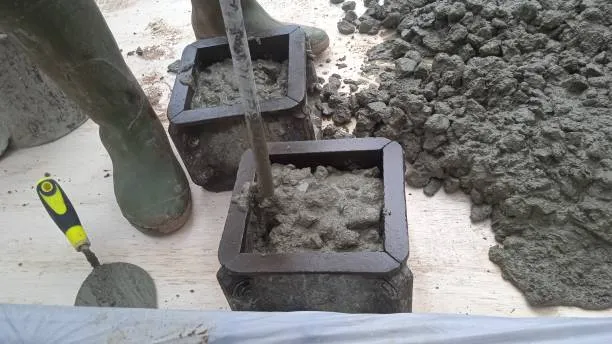
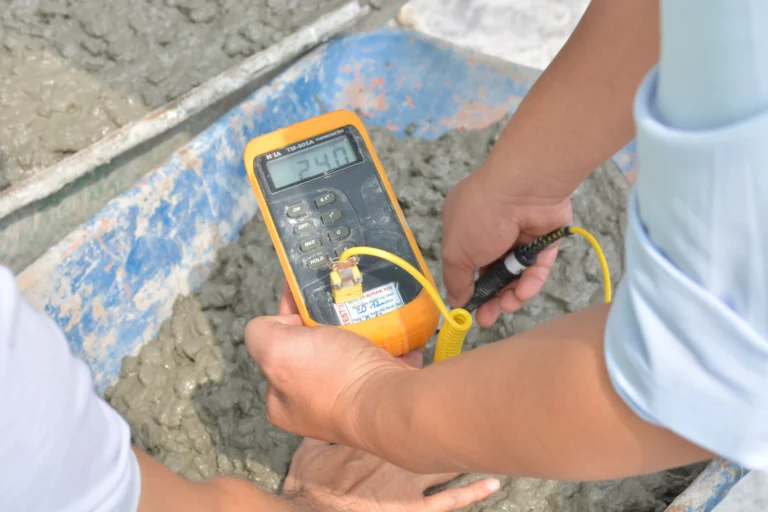
Forget the idea that cube testing is paperwork. It is a direct strength check.
Here is how it works under SANS 5863:2006 – Concrete Tests – Compressive Strength of Hardened Concrete:
Casting: On site, we cast cubes using metallic molds measuring 100 x 100 x 100 mm or 150 x 150 x 150 mm steel cube mould. Per SANS 5863, three cubes constitute one sample. Fresh concrete is placed in layers, tamped, and labelled with slab location, date, and grade – e.g., “First Floor Lounge – 30 MPa – 04 Nov”.
Curing: Cubes are cured for 28 days in water tank – standard for South Africa. Some are also tested at 3, 7, 28, 56, 120 and 180 days for research, but acceptance is based on 28 days. The design strength is 35 MPa at 28 days for higher-grade mixes, 30 MPa minimum for normal reinforced structures, 40 MPa for suspended slabs and beams per eThekwini notes.
Crushing: Lab testing is per SANS 5863. Test specimens are crushed between two platens in hydraulic press. Rate of load application influences compressive strength results and is specified at uniform rate of 0.3 MPa/s ±0.1 MPa/s. Earlier references note 140 kg/cm2 per minute till specimen fails and 0.25 MPa/s for automated machines. The machine applies load to defined opposite faces until specimen fails. Dividing maximum recorded load by loaded face area gives compressive strength in MPa.
Result: A valid test result is average result obtained from testing of three test specimens of concrete in accordance with SANS 5863. That average is compared to characteristic strength. In South Africa, project specifications refer to characteristic strength derived from statistical analysis. Must attain 99.3% strength on 28th day cube test result and tests are considered deciding criterion for acceptance.
For bespoke concrete slabs KZN – especially suspended slabs with bespoke shapes – we test every 25m3 or every pour, whichever is less. That is stricter than minimum, but it is how you catch a bad batch before it becomes a structural slab.
Bespoke slabs are not standard. A standard 170mm slab on blockwork is predictable. A 250mm cantilevered slab with hidden beams, curved edge, and 4.5m span is not.
Two most common kinds of failure are: failure to get required strength, concrete being otherwise apparently good; structural failures, such as honeycombing, sandy patches, and cracking. Failure to get right strength in cubes taken from pour can have very simple cause.
Common causes we see in Durban and Pinetown:
1. Water added on site. Ready-mix arrives at 80mm slump, workers add water to make it flow easier – slump goes to 140mm. Strength drops 8-12 MPa immediately. Cube test catches it. Visual inspection does not.
2. Poor curing in KZN heat. November in Pinetown – 32°C, concrete poured at 11am, no curing membrane, no water. Surface dries, hydration stops at 60%. Cube cured properly in lab still achieves 30 MPa, but in-situ slab achieves 19 MPa. That mismatch is why we require both cube test and hammer test correlation.
3. Inadequate compaction around reinforcement. Honeycombing is most usually caused by inadequate vibration or rodding of concrete adjacent to face of formwork. Bespoke slabs have congested reinforcement – Y16 @ 200 top and bottom, plus Y10 stirrups in beams. Without proper vibration, you get voids under bars. Cube may pass, but slab has weak zones. That is why we also check cover to reinforcement: Slabs – 30mm per SANS 10100 – and enforce spacer blocks.
For bespoke concrete slabs KZN, the cost of not testing is not theoretical:
Professional concrete cube testing Durban costs R450-R750 per sample of 3 cubes – R1,800 to R3,000 for a typical house. The ratio is obvious.
This is where process matters more than panic.
Per IS 456:2000 Clause 15 and South African practice aligned to SANS, when 28-day cube strength fails to meet requirements, following sequence is generally followed:
Step 1: Check the test itself.
Failure of concrete cube is serious issue. First you have to analyze why cubes have failed. By assessing proper reason for failure, we may proceed for next process. Verify specimen preparation, curing conditions, machine calibration. Were cubes not filled properly or not cured properly in first 7 days? If cubes were badly made, slab may still be okay. If 28 days result fails then again there is possibility that cubes are not filled properly or not cured properly in first 7 days. But it is possible that slab concrete is OK. Go for Hammer test.
Step 2: Rebound hammer and UPV as screening.
Non-destructive tests – rebound hammer and ultrasonic pulse velocity – give indication of in-situ uniformity. If hammer shows >85% of cube strength consistently, confidence increases.
Step 3: Core testing – the definitive check.
If core test failed for slab which happens very rare, consult designer for formulated advice whether strength is UN-acceptable as per Design codes. Core test is direct measure of in-place concrete. If test failed area is of mass concrete, retain concrete with rectification like Grouting method. Grouting can be considered to improve concrete quality followed by Hammer test before deciding for dismantling slab as Final decision.
In KZN practice for bespoke concrete slabs KZN, if core strength is <85% of characteristic strength (e.g., <25.5 MPa for 30 MPa design), we trigger structural review per SANS 10100-1 The structural use of concrete – Part 1: Design. Options: strengthen with additional steel, grout, or in worst case – demolish.
That is why we enforce concrete cube testing Durban before any slab is de-shuttered for loading. In our JBCC, slab cannot be loaded with blocks/bricks until 28-day cube result achieves required strength or 7-day result shows 65-70% of 28-day with engineer’s approval.
Two South African standards govern every bespoke slab we pour in Durban and Pinetown:
SANS 5863 – Testing.
SANS 5863:2006 – Concrete Tests–Compressive Strength of Hardened Concrete; SANS 5863-3; South African Bureau of Standards: Pretoria. Also referenced as SANS 5863:2006e – This test involves using three cubes, all from same sample of concrete. South African National Standards, 2006. Concrete Tests-Compressive Strength of Hardened Concrete, SANS 5863:2006. This is test method – how you crush, rate, and average.
Key points from SANS 5863 for concrete cube testing Durban:
SANS 10100 – Design and Execution.
SANS 10100-1 (SABS 0100-1), The structural use of concrete – Part 1: Design and Part 2: Material and execution of work. And SANS 2001-CC1: Concrete works (structural) – suitable for construction of concrete work designed in accordance with requirements of SANS 10100-1.
Critical clauses for bespoke concrete slabs KZN:
When you combine SANS 10100 design (30-40 MPa) with SANS 5863 verification (crushing at 28 days at 0.3 MPa/s), you get a closed loop: design strength specified, delivered strength verified.
That loop is missing on most non-compliant sites in Pinetown where builders pour and hope.
Standard rectilinear slab: Load paths simple, reinforcement uniform, risk low.
Bespoke slab: Curved edges, hidden beams, cantilevers 1.8m-3.2m, double-volume voids, point loads from feature staircases. Structures have been built on variety of foundations such as heavily reinforced concrete rafts, light footings directly on surface – same principle applies to slabs – heavily reinforced bespoke slabs behave differently.
For bespoke slabs in Durban:
Result: More cubes, more data, less risk. Concrete cube testing is one of most important quality control activity in any construction project. It provides direct measure of whether concrete delivered and placed on site meets required strength as per design and contract specifications. However, when concrete cube failure happens, results fail to achieve targeted compressive strength, it raises immediate concerns regarding structural safety, workmanship, material quality, and compliance with standards. A failed result prompts investigation rather than immediate verdict.
That investigation culture is what protects bespoke concrete slabs KZN.
Here is the exact process we follow at MH Homes for every bespoke slab in Durban and Pinetown – no shortcuts.
1. Pre-pour check – Mix design verification
We confirm ready-mix supplier mix design – optimal mix contained 50% fly ash replacement and achieved compressive strength of 37.3 MPa at 28 days, meeting target strength 30 MPa. Supplier must provide 30 MPa mix with 19mm stone, slump 80mm ±20mm, water-cement ratio ≤0.55. We check batch ticket on arrival.
2. On-site casting – SANS 5863 compliant
Three cubes per sample, 100mm cube specimens tested at ages of 7, 28, and 56 days using automated hydraulic compression machine at loading rate 0.25 MPa/s (lab) / 0.3 MPa/s site spec. Cubes filled in two layers, each tamped 35 times with tamping rod, top finished, labelled. Cured initially on site in damp hessian for 24 hours, then transported to lab for 28 days water curing.
3. Lab testing and acceptance
Lab crushes at 7 days for early indication – we need ∼65-70% of 28-day characteristic – and 28 days for acceptance. Compressive strength test method (SANS 5863) – Test specimens are crushed between two platens in hydraulic press. Rate of load application influences results and is specified at uniform rate of 0.3 MPa/s ±0.1 MPa/s. Valid test result is average result obtained from testing of three test specimens.
If 28-day average ≥30 MPa (or ≥40 MPa for suspended bespoke), slab passes. If <30 MPa, we follow failure protocol: check curing, check batch records, identify affected area from cube marking, call for cores if needed.
4. Documentation for eThekwini and NHBRC
Every concrete cube testing Durban result is filed with SANS 10400-A Form 4 – Certificate of Completion and structural engineer’s completion certificate. In South Africa, project specifications refer to characteristic strength derived from statistical analysis. That file is required for occupation certificate. No cube results = engineer will not sign Form 4 for bespoke slab.
5. Fixed price protection
Our JBCC includes: “No additional concrete or rectification costs after cube failure due to supplier error – supplier and contractor to rectify at own cost to achieve 30 MPa characteristic strength per SANS 5863.” Client does not pay for bad concrete. That is why concrete cube testing Durban is enforced – it allocates risk correctly.
External technical references we include on every bespoke slab file: SANS 5863 – Concrete Tests–Compressive Strength of Hardened Concrete – SANS 5863-3 – South African Bureau of Standards Pretoria at https://www.sans.org.za, AfriSam – Properties of Hardened Concrete – Compressive strength test method (SANS 5863) – 0.3 MPa/s ±0.1 MPa/s – average of three specimens at https://www.afrisam.co.za, Eskom Safety Case Template – Concrete Pads cast-in-place concrete tested at 28 days to ensure minimum and maximum cube compressive strength 30 MPa and 51.7 MPa per SANS 5863 at https://www.eskom.co.za, Civil Quality Control – Concrete Cube Failure – What Next – direct measure whether concrete delivered meets required strength at https://www.civilqualitycontrol.com.
If you are building a bespoke slab in KZN – a cantilever, a curved deck, a double-volume feature – do not let anyone pour without a cube testing plan.
Ask three questions:
If builder cannot answer with SANS 5863 and SANS 10100 references, you are carrying the risk.
Concrete cube testing Durban costs less than R3,000 per house. A failed bespoke slab costs R95,000 to R180,000 to fix. The maths is simple.
For bespoke concrete slabs KZN in Durban and Pinetown, we enforce professional cube testing because we have to sign SANS 10400-A Form 4 and structural completion certificate. Our name goes on that slab for 5 years under NHBRC.
Bring your slab drawings to MH Homes, 33 Helen Joseph Road, Durban. We will review grade, thickness, cover, and cube testing frequency for your reinforced slabs Pinetown – no charge for initial review.
Build it once. Test it. Know it is right.
Internal links: Explore our new house building service for Durban and Pinetown bespoke slabs, SANS 10100 structural design and concrete cube testing service, reinforced concrete slabs and suspended slabs engineering, NHBRC enrolment and occupation certificate service, and contact our Durban office for your free concrete slab audit.
Got questions about your project? Let's chat!
MH Homes | Privacy policy
Message MH Homes on WhatsApp